In the 1960s, television in Ireland was fairly straightforward. There was one Irish channel, and if your aerial was good enough, high enough and pointed in the right direction, you might also pick up a few English channels.
The aerial was usually attached to a pole about twenty feet above the house. Somebody would be shouting instructions while another person outside tried to turn the aerial.
“A bit to the left.”
“No, the other left.”
“Hold it there.”
That was the television installation in those days.
My granny was one of the first people in her part of rural Donegal to get a television. Her eldest son had done well and wanted his mother to have a bit of company and pleasure in what could be a lonely life.
The television had a fourteen-inch screen, although the wooden cabinet around it was large enough to house a small family. It sat in the corner of the room like an important visitor. And, yes, she had electricity by now.
When we came to stay with Granny during the summer holidays, we noticed something strange happening every Wednesday evening.
People began appearing over the hills.
They came along lanes, across fields and through gaps in hedges, usually men, would arrive at the door, give a quick greeting and find somewhere to sit.
“How are you, Annie?”
“Not too bad.”
“Grand evening.”
There was no need to explain why they had come. Everyone knew.
Coronation Street was on.
The room would fall completely silent as soon as the music started. Every eye was fixed on that small, grainy screen. Nobody spoke. Nobody moved unless the picture started rolling, in which case someone would get up and fiddle with the knobs.
If that failed, the side of the television was given a firm slap.
This often worked, which was probably why people had great faith in the method.
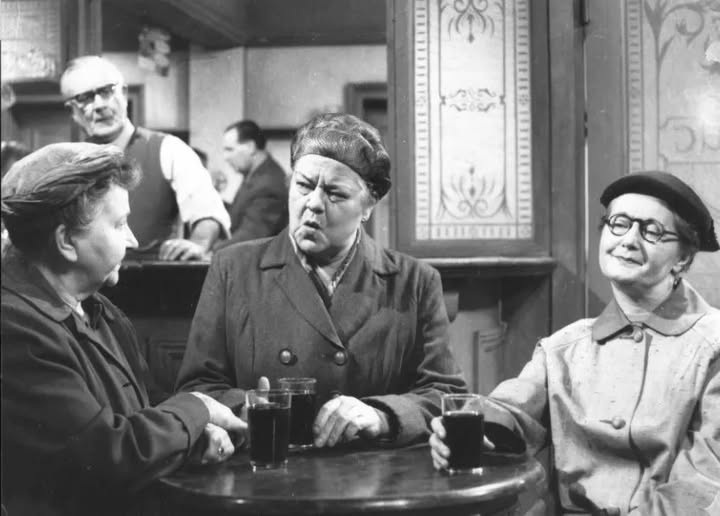
For half an hour, a roomful of Donegal people watched the lives of people in a Manchester street. Ena Sharples and Elsie Tanner were discussed as if they lived a few miles away.
Once the programme ended, everyone stood up.
“Well, that’s us.”
“Goodnight, Annie.”
“See you next week.”
And off they went again, disappearing over the hills almost as quickly as they had arrived.
I often wonder what Granny made of it all. Perhaps she found it a nuisance. Perhaps she enjoyed being the most important woman in the district for one evening a week.
For half an hour every Wednesday, Granny’s house was the local cinema.Today, we have more channels than we know what to do with. There are fourteen free ones and hundreds more if you are willing to pay for them. Then there is Netflix, Amazon, Disney and several others that seem to arrive on the bank statement without anyone remembering joining them.
Despite all these choices, we still sit down in the evening and say, “There’s nothing on.”
We spend twenty minutes scrolling through films and programmes.
“Too violent.”
“Too miserable.”
“I don’t like him.”
“We watched that.”
“No, we started it and gave up.”
Eventually, we end up on one of the Gold channels watching an episode of Only Fools and Horses that we have already seen several times.
We know what Del Boy is going to say. We know Rodney’s answer. We know the chandelier is coming down.
But we watch anyway.
Or we turn on a nature programme and become emotionally attached to a small animal trying to cross a river. Then a crocodile appears, and we change the channel because we cannot take the stress.
Once a year, the local drama group puts on a play. It is usually a farce, with doors opening and closing, people hiding in cupboards, and someone’s wife turning up.
The actors all have ordinary jobs. They are farmers, builders, teachers, shop workers, and people you might meet in the post office. None of them is likely to be nominated for an Oscar.
It does not matter.
Every year, we leave the hall with tears running down our faces from laughing and already looking forward to the next one.
Today, our neighbours called around to discuss a maintenance problem. The problem itself took about ten minutes to sort out.
Five hours later, we were still talking.
There were stories from the past, old houses, family connections and things that had happened forty years ago. Some of the stories had probably improved a little over time, but that only made them better.
Eventually, we had to bring the evening to an end, though nobody seemed in any hurry to leave.
I could not sit through a five-hour film. I would struggle with five episodes of a box set.
But five hours of conversation had passed without anyone noticing.
Maybe entertainment is not something we need to subscribe to. Perhaps it is already around us.
It is neighbours calling in, a local play, an old story and people appearing over the hills on a Wednesday night to watch Coronation Street on a fourteen-inch television.
And not one of them needed a password.