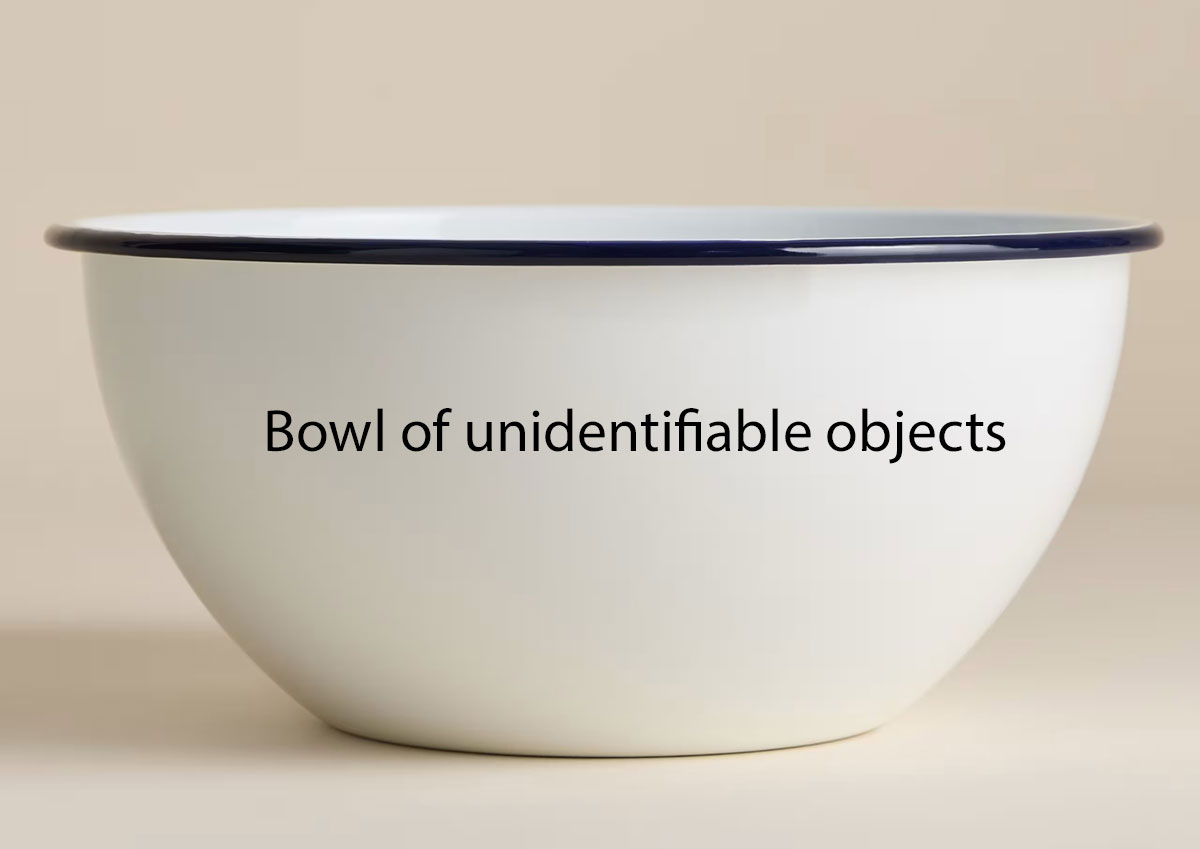
In our house there’s a bowl full of things that nobody can identify.
I’m told nearly every house has something similar. Some people have a drawer, which is probably worse because a drawer can hold far more rubbish than a bowl.
Mine contains all the little things I find lying around the house that look as though they must belong to something.
There are screws, plastic clips, rubber rings, little brackets and various bits of plastic. One or two look quite important. The worrying thing is that I have no idea what any of them are for. It’s like an asylum centre for things that have no verified identity.
You find one on the floor and pick it up.
“What’s this?”
Nobody knows.
“Did it fall off something?”
Nobody knows that either.
So, into the bowl it goes.
The sensible thing would be to throw it away, but you can’t do that. We all know what happens when you throw away something you’ve kept for years.
Two days later you need it.
I could keep a mysterious plastic clip for fifteen years without ever discovering its purpose. The day after I finally put it in the bin, somebody will say, “There should be a little plastic clip on the back of this.”
And I’ll know exactly where it is.
Somewhere underneath three days of general decomposing waste.
So, I keep everything.
Every now and again I empty the bowl onto the table and have another look, as if the passing of time might have improved my knowledge of small engineering components.
It hasn’t.
I pick things up and wander around trying them against various appliances.
Dishwasher?
No.
Coffee machine?
No.
Vacuum cleaner?
Could be.
That’s enough uncertainty to put it back in the bowl for another five years.
There’s one particular metal thing that bothers me. It looks as though it performs an important function. I have absolutely no idea what that function might be, but it has the look of something you shouldn’t lose.
I’ve had it for years.
Everything in the house still works.
I’m beginning to think it may have belonged to something we no longer own, which should make it safe to throw away. But what if it doesn’t?
Back in the bowl.
At my age, the problem is becoming more serious because the collection is growing faster than my ability to remember where anything came from. Some of these things could date back several televisions, two vacuum cleaners and a dishwasher.
There may even be parts of appliances belonging to people who no longer live here.
What I need is a support group.
We could call it Unidentified Household Objects Anonymous.
We’d meet once a month, bringing along one item we were thinking of throwing away.
“My name’s Ian and I’ve had this rubber washer since 2017.”
“Hello, Ian.”
“I don’t know what it’s for.”
There would be sympathetic nods around the room.
Then the group leader would ask the big question.
“Do you feel ready to throw it away?”
“Absolutely not.”
And everyone would understand. There’d be a twelve-step programme, I’m sure, but nobody would actually throw anything away until at least Step Twelve.
Eventually, after several months of counselling, I might be persuaded to part with one small piece of plastic.
I’d put it in the bin.
Then, just before the bin lorry arrived, I’d take it back out.
You never know.