I can’t remember exactly what age I was, but at some point in my school career it was decided that I was mature enough to be trusted with a fountain pen.
This was a serious misjudgement.
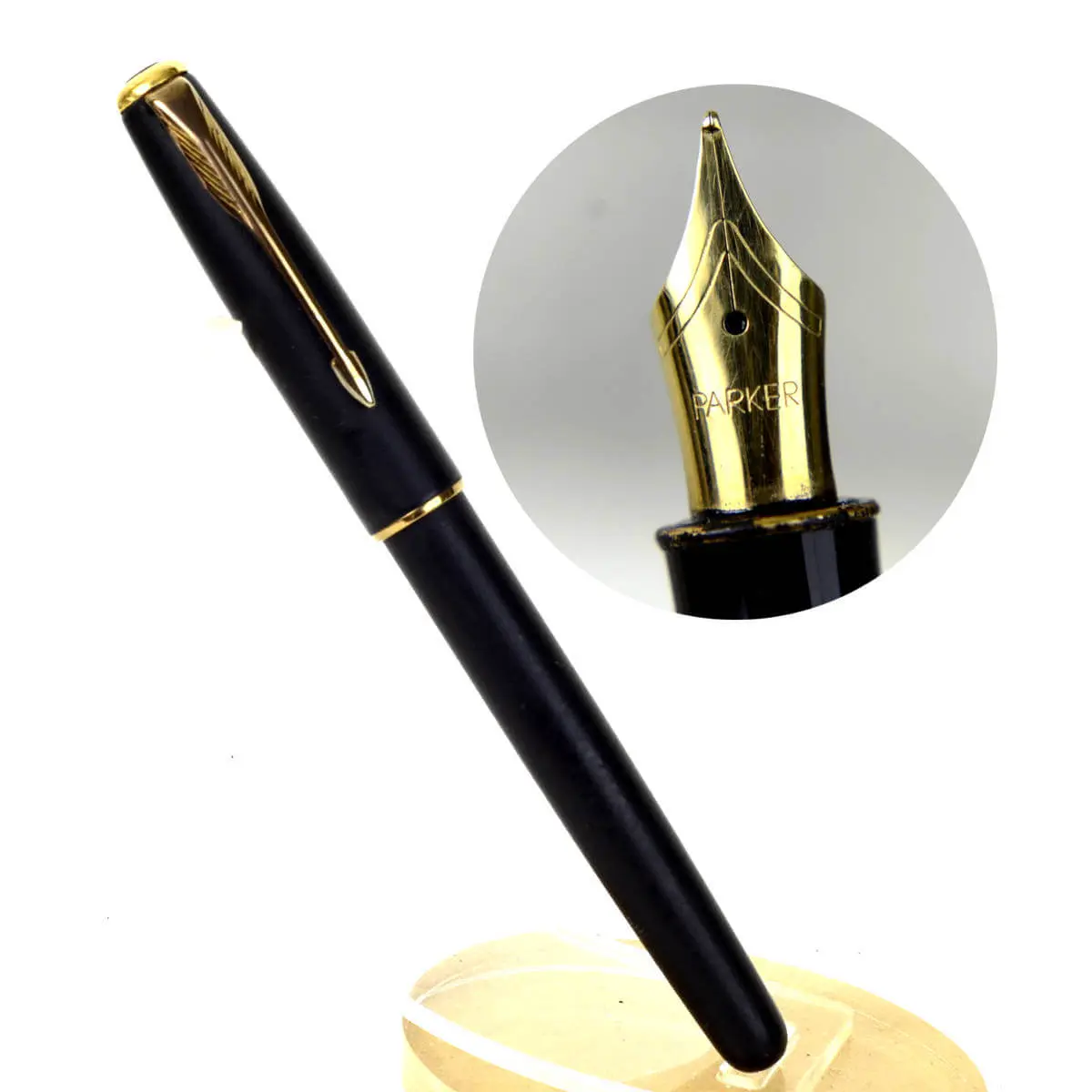
In those days you couldn’t just turn up with any old writing implement. A biro was regarded with much the same suspicion as chewing gum or a flick knife. Proper schoolchildren wrote with fountain pens, and in the 1960s that usually meant a Parker.
My first Parker had to be filled from a bottle of Quink. This involved unscrewing the pen, dipping part of it into the ink and operating a little filling mechanism while trying not to cover yourself, the desk and the child beside you in permanent blue-black stains.
It was supposedly a writing system. In practice it was closer to refuelling an aircraft.
The Quink bottle then went into the schoolbag, where it spent the rest of the day lying beside textbooks, exercise books and sandwiches.
What could possibly go wrong?
Quite a lot, as it turned out.
I lost count of the number of times a Quink bottle leaked. You would open the schoolbag and discover that everything inside had become part of one enormous abstract artwork. Geography books were blue. Maths homework was blue. The corner of your cheese sandwich was blue.
You could explain to the teacher that Parker had failed to design a bottle top capable of surviving the journey to school, but this cut very little ice.
The teacher’s view was that Parker was a respected international company and therefore the fault must somehow be mine.
Many a detention probably had its origins in a loose Quink cap.
Then came ink cartridges.
What a magnificent invention. No bottles. No refilling. No schoolbag looking as though a squid had exploded inside it.
Naturally, this great leap forward arrived just as I was getting near the end of my school days.
That has happened to me repeatedly in life. Technology solves a problem just after I have spent twenty years putting up with it.
Then, almost unbelievably, schools began allowing ballpoint pens.
The biro had arrived.
You simply took the cap off and wrote.
There was no ink bottle. No filling mechanism. No blotting paper. No possibility of turning your English essay into a Jackson Pollock abstract painting.
It felt slightly immoral.
Despite all this, I remained loyal to Parker pens for years. There was something about them. The shape, the little arrow clip, the reassuring weight in the hand. A Parker made you feel that whatever you were about to write might be important.
Even if it was only a shopping list.
Later in life I developed notions.
Parker was no longer enough. I discovered Montblanc and other expensive pens of the sort used by people who sign treaties, company takeovers and very large cheques.
I bought a few.
A premium fountain pen has a remarkable effect on a man. You can be sitting at the kitchen table in your slippers writing “milk, bread, bin bags” and still feel vaguely like the chairman of a Swiss bank.
I still have some of those pens.
Unfortunately, modern life eventually defeated them.
Work demanded speed, so the elegant fountain pen was replaced by packs of cheap biros. Twenty for a few pounds. Pens you had no emotional attachment to whatsoever. If you lost one you didn’t mourn it. You simply reached into a drawer and found another seventeen.
Then came the computer.
This, we were told, was progress.
For someone who could write quite quickly by hand, my early encounters with a keyboard suggested otherwise.
I was a one-finger typist.
I would compose a sentence beautifully in my head, locate the first letter on the keyboard, press it, then begin searching for the second.
By the time I had typed the sentence I had forgotten what the paragraph was about.
Then came the corrections. Missed letters. Extra letters. Words that appeared to have been typed by someone falling downstairs.
Eventually I improved.
I am now a two-finger typist.
This has doubled productivity.
Of course, email finished off letter writing almost completely. We gained instant communication but lost something along the way. Nobody receives an email and says, “What lovely handwriting.”
Nobody keeps an email because they admire the paper.
Nobody opens a drawer forty years later, finds an old WhatsApp message and notices the faint smell of Quink.
Every now and again I still feel the urge to go back.
I imagine taking one of my old Parker pens from the drawer, finding a sheet of Basildon Bond writing paper and sitting down at a proper desk.
I would fill the pen, carefully this time, and begin writing slowly in the handwriting that schoolteachers spent years trying to knock into me.
It would be wonderfully nostalgic.
Although before I started, I would check the Quink bottle lid.
Some childhood experiences never leave you.