As part of our late-life attempt at becoming sophisticated, we have discovered gourmet dining.
This is not to be confused with going out for a meal. Going out for a meal is where you look at a menu, pick something you actually recognise, eat it, and go home full. Gourmet dining is a different sport altogether.
First, you have to book the restaurant months ahead. Not days. Months. You put your name on a waiting list and then act delighted when they ring to say there’s been a cancellation at some awkward time on a wet Tuesday. You accept immediately, because people like us don’t get many chances to eat in places where the napkins are folded like bishops’ hats.
When you arrive, you are greeted by the maître d’, a man so smooth he looks as if he has never had indigestion in his life. He welcomes you as if you are terribly important, while also giving the faint impression that he knows you once ate Findus Crispy Pancakes and enjoyed them.
He shows you to the table and asks if you would like drinks.
This is where the panic starts.
You haven’t seen the food yet, so how are you supposed to know what to drink? You can’t order red wine in case the meal turns out to be fish. You can’t order white in case it’s beef. You can’t say, “What do you recommend?” because that reveals you know nothing. And you certainly can’t ask for a pint, because your partner will kick you under the table hard enough to require surgery.
So, you order a cocktail.
This seems safe until it arrives.
It comes in a glass roughly the size of a communion cup, with one giant ice cube and a sprig of something that looks as if it were stolen from a hedge. The drink itself is described as having notes of elderflower, smoked rosemary and citrus mist. It costs about the same as a decent pair of shoes.
Then the menu arrives.
Except it isn’t really a menu. A menu suggests there might be a choice. This is more like a set of instructions from the kitchen. You are having what they have decided, and you are expected to be grateful.
There is a short tasting menu and a long tasting menu. The short one makes you look cheap. The long one makes you worry about the mortgage. Then there is the wine pairing, which is presented as optional in the same way that breathing is optional.
You look at your partner.
Your partner gives you the look.
So, you order the full thing with the wine.
At this point, the maître d’ returns to explain the meal. This takes longer than some weddings.
There will be beetroot three ways, though you never asked for beetroot one way. There will be fermented things, reduced things, cured things, smoked things, and something “finished at the table”, which sounds like a threat.
You nod along like a man who understands.
You do not understand.
Then the first course arrives.
This is not simply food arriving. This is theatre. Three members of staff approach the table. One carries the plates on a tray and stands silently several yards away, like a witness waiting to give evidence. The maître d’ explains the dish in a tone that suggests the kitchen has suffered greatly for your benefit. Then another silent member of staff places the plate in front of you.
You look down.
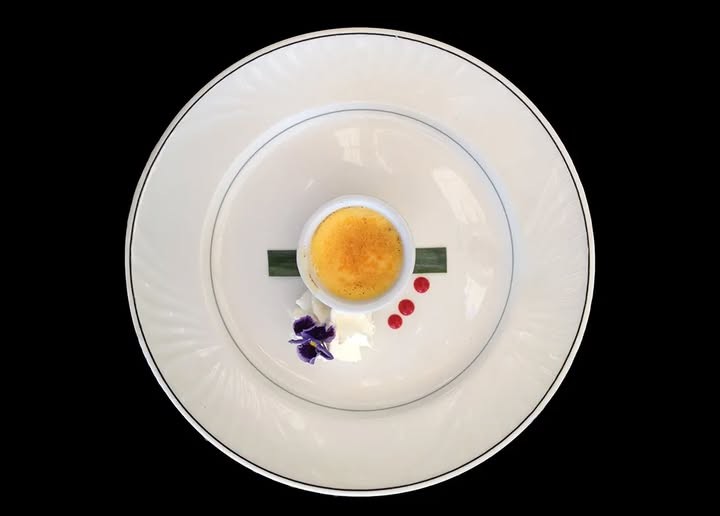
There is a tiny object in the middle of the plate. Around it are dots. Chefs love dots. Put three dots beside anything, and suddenly it’s fine dining. A man could serve a boiled button if he added dots and called one of them a purée.
The explanation has taken two minutes.
The eating takes twelve seconds.
To be fair, it is delicious. That is the annoying thing. Just as you are preparing to dismiss the whole business as nonsense, the food turns out to be wonderful.
But it is very small.
This pattern continues for several courses.
A carrot is no longer a carrot. It is heritage carrot, cooked in hay, glazed with its own juices, served with miso and a memory of smoke. Bread is no longer bread. It is sourdough with cultured butter. Even the butter has been to university.
Each dish arrives with a story. The fish was caught that morning by a man with weathered hands. The herbs were foraged locally. The lamb came from a farm where it probably had a better upbringing than most children in the 1950s.
Then came the deconstructed ratatouille.
Now, I like ratatouille. At least I thought I did. In my head, ratatouille is a hearty dish. Peppers, tomatoes, onions, courgettes, garlic, olive oil — the sort of thing that looks as if somebody’s mother has been busy in the kitchen.
This was not that.
The maître d’ described it with great reverence. The vegetables had been separated, gently prepared, and allowed to “express themselves individually”. I looked down at the plate. There was one slice of pepper, half a tomato, and a small sliver of onion lying there like survivors from a boating accident.
That was it.
A deconstructed ratatouille, apparently. In our house, that would be called “not enough left in the fridge to make an omelette.”
You admire the skill. You really do. But after a while, you start wondering whether this is dinner or an art exhibition. You know the sort of thing. A pile of bricks in the corner, and everyone standing around saying how brave it is.
There is a lot of bravery in gourmet dining.
Mainly from the customer.
By the fifth course, you are no longer sure whether you are hungry, full, impressed or slightly frightened. The wine keeps arriving in small glasses, each one explained with great seriousness. You say “lovely” every time, because that is the full range of your wine knowledge.
Then comes dessert.
Dessert is beautiful. Too beautiful, really. It looks less like food and more like something that should be kept in a glass cabinet. There is chocolate, but not enough to do any damage. There is sorbet balanced on a crumb. There is a leaf. There is always a leaf.
Finally, coffee arrives with petits fours, which are tiny sweets designed to make you feel wealthy while still leaving room for regret.
Then comes the bill.
It arrives in a little leather folder, which is never a good sign. Nobody brings good news in a little leather folder.
You open it carefully.
The figure inside is impressive. Not impressive in a good way. More in the sense that it would feed a family of six for a fortnight, provided they avoided restaurants with silent staff and edible flowers.
You pay. You smile. You say it was wonderful.
And, in fairness, it was. The food was beautiful. The service was flawless. The whole thing was an experience.
But was it a meal?
That is the question.
You leave feeling cultured, poorer, and not entirely certain that you have eaten enough to sustain life.
Half an hour later, in the car, there is silence.
Then one of you says it.
“Are you still hungry?”
Another silence.
“A bit.”
Then the words that bring the evening back down to earth.
“Fancy a McDonald’s?”
And suddenly, after all the foam, reductions, foraged herbs and hand-dived scallops, everything feels normal again.