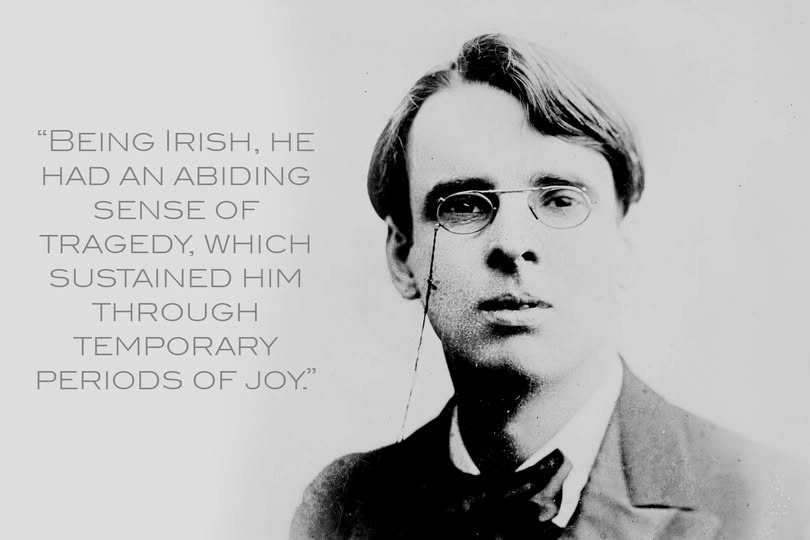
“Being Irish, he had an abiding sense of tragedy, which sustained him through temporary periods of joy.”
W. B. Yeats supposedly wrote that, and it is hard to improve upon. Most nations regard happiness as something to be encouraged. We treat it with suspicion. If things are going particularly well, an Irish person will usually say, “It won’t last,” just to prevent anyone becoming overexcited.
Nowhere is our fondness for misery more obvious than in our music.
At major sporting events, thousands of cheerful Irish supporters will link arms and joyfully sing about a starving man stealing corn from a landlord and being transported to Australia. The louder and happier the crowd becomes, the more terrible the story appears to be.
Then there is Grace, a deeply tragic song about Joseph Plunkett marrying Grace Gifford in Kilmainham Gaol shortly before his execution. Naturally, it has become popular at weddings and hen parties.
Nothing captures the solemnity of the occasion quite like twelve women in matching pink T-shirts, waving inflatable objects in the air and shouting, “Oh, Grace, just hold me in your arms!” before ordering another round of shots.
Even The Rocky Road to Dublin is performed at a speed suggesting that everyone involved is having the time of their lives. Listen to the words, however, and it is largely the story of an Irish emigrant being cheated, attacked, mocked and generally mistreated from Mullingar to Liverpool.
Yet we sing it as though he has just won the Eurovision Song Contest.
Our music is full of eviction, exile, imprisonment, lost love, early death and people standing sadly beside rivers. But add a fiddle and a bodhrán and suddenly the entire pub is dancing.
This may also explain our devotion to the underdog.
In Britain, football supporters are expected to support their local team, although many quietly keep a more successful “second team” for emergencies. A man might claim lifelong devotion to a struggling club while wearing a Manchester City shirt and checking the Champions League results.
In the GAA, such behaviour would be viewed with deep suspicion and possibly a tribunal before the county board.
When Mayo reached the All-Ireland final after waiting an eternity for success, practically the whole country adopted them. Their opponents had the trophies, the tradition, and the confidence. Mayo had 75 years of disappointment, several heartbreaking defeats and possibly a curse.
There was only ever going to be one neutral favourite.
Everyone outside Kerry was shouting for Mayo. Some Kerry people were probably shouting for them as well, although discreetly and behind closed curtains.
And when Mayo finally won, the country celebrated as though a great national burden had been lifted. Even Kerry supporters offered congratulations, shook hands and said they were delighted for them, which must have caused Mayo people to wonder whether they were dreaming.
But Irish sympathy has strict limits.
Mayo are champions now. They have experienced joy, success and public admiration. That makes them dangerously close to being favourites.
Next year, the country will find another unfortunate county that has not won anything since the invention of electricity. We will learn its history, discuss its decades of suffering and enthusiastically support it against Mayo.
Mayo, meanwhile, can go back to waiting.
After all, temporary periods of joy are all very well, but we cannot allow them to become a habit.