Before Google, and back in my increasingly ancient past, there was no quick way of finding out the answer to something and then pretending you had known it all along.
If you didn’t know something, you generally remained not knowing it.
There were really only two alternatives.
One was the local library. Libraries were excellent places, but they operated on the unfortunate principle that they should be closed whenever you urgently needed to know something. If an argument broke out at half past nine at night about who invented the vacuum cleaner, there was very little chance of settling it before Tuesday.
The other option was an encyclopaedia.
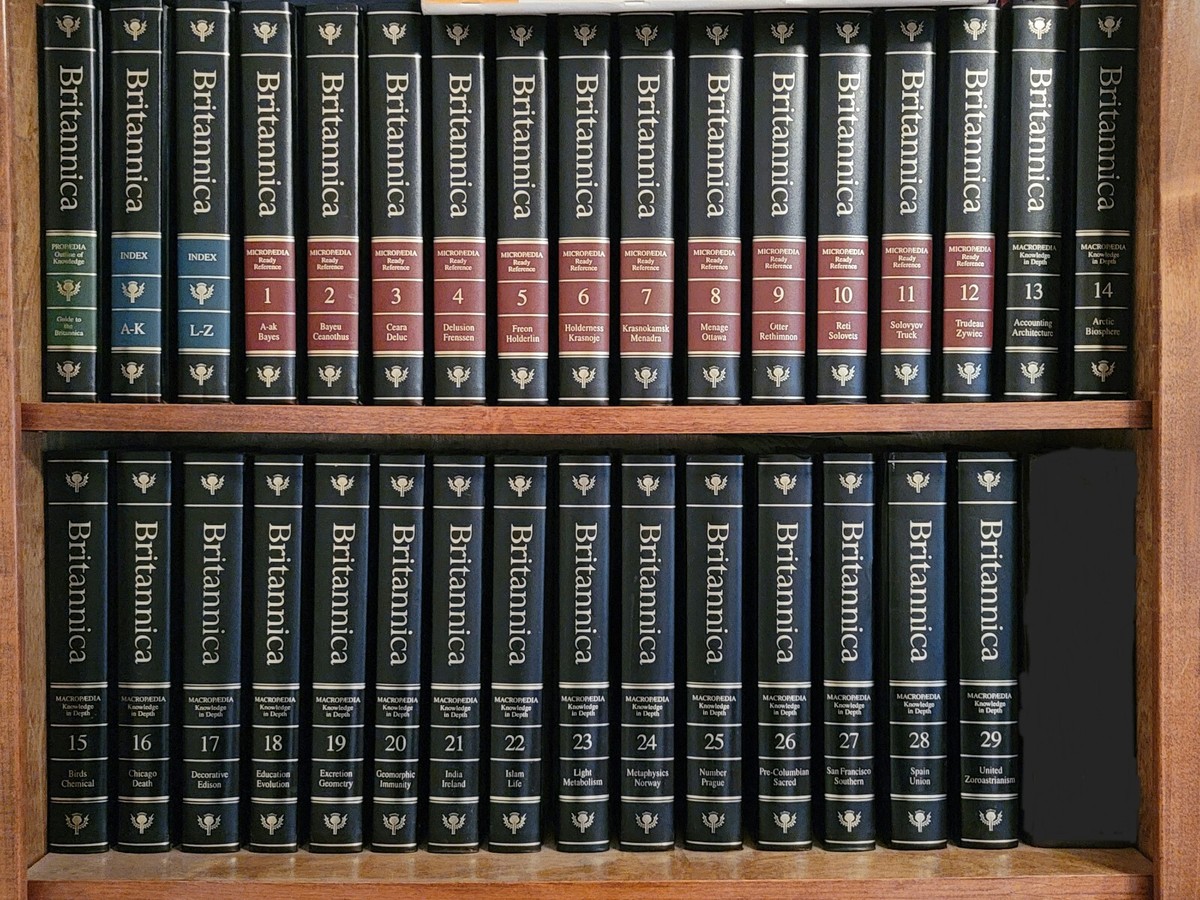
An encyclopaedia was basically Google spread over about thirty enormous books, occupying an entire shelf and weighing roughly the same as a small car.
The king of them all was the Encyclopaedia Britannica. People who owned Britannica were obviously successful. They had carpets, matching furniture and children who were expected to become doctors.
We didn’t have Britannica.
It was far beyond our family budget.
Then one day, a travelling salesman arrived at the door.
Travelling salesmen were very persuasive people. They could arrive at your house when you wanted absolutely nothing and leave twenty minutes later having sold you something on monthly instalments for the next six years.
This particular man quickly established that my parents had children.
This was apparently serious.
Without an encyclopaedia, he explained, their children could be left behind educationally.
I imagine my parents looked across at me and thought this was already happening.
Luckily, the salesman had the solution.
His company produced an encyclopaedia that was considerably cheaper than Britannica. Better still, we didn’t even have to buy the whole thing at once.
It would arrive in monthly instalments.
This must have sounded very modern.
Soon afterwards, sections of our encyclopaedia began arriving through the post.
There was tremendous excitement at first.
We now had knowledge in the house.
Admittedly, it wasn’t Britannica-level knowledge.
Our encyclopaedia had the general appearance of something that had been compiled quite quickly by three men in an office above a carpet shop.
But it was information, and information was information.
We started with A.
Aardvarks.
Abraham Lincoln.
Afghanistan.
Aeroplanes.
Algebra.
I became extremely well informed.
Then B arrived.
Then C.
Month after month, civilisation slowly entered our house in alphabetical order.
The trouble was that, after a while, the novelty wore off.
My parents also began to notice that the monthly instalments were continuing with alarming regularity.
Eventually, they cancelled the subscription.
Unfortunately, they did this before the encyclopaedia was complete.
This had a profound effect on my education.
For much of my early life, I was extremely knowledgeable about anything beginning with the letters A through L.
Ask me about astronomy, Beethoven, crocodiles, Denmark or King Henry VIII and I could hold my own in any conversation.
But once we reached M, things became increasingly uncertain.
Mozart? Vague.
Napoleon? Nothing.
Physics? Not a clue.
Zambia might as well have been on another planet.
If I ever appeared intelligent as a child, it was important to keep the conversation in the first half of the alphabet.
Then, many years later, along came the internet.
And eventually Google.
Suddenly the entire sum of human knowledge was available within seconds.
This completely changed arguments.
Previously, two people could argue for an entire evening about who played the lead role in a particular film.
Neither knew.
That was part of the entertainment.
Eventually someone would say, “I think it was Richard Burton.”
Someone else would say, “Definitely Peter O’Toole.”
And the matter might remain unresolved for twenty years.
Google ruined all that.
Now somebody immediately takes out a phone.
“Hang on.”
Three seconds later:
“It was Michael Caine.”
Argument over.
No fun at all.
Google also revolutionised pub quizzes and Trivial Pursuit.
For the first time, cheating became technically possible.
The difficulty was operating your smartphone underneath the table without anybody noticing.
This required a special skill.
You had to stare confidently ahead while secretly typing:
Who invented the toaster?
Unfortunately, people tend to notice when someone spends two minutes staring straight ahead while moving both thumbs underneath the table.
Today, of course, we have AI.
Cheating has entered a completely new era.
You don’t even need to type.
All you have to do is discreetly activate speech mode.
Then, when someone asks a difficult question, you lean back thoughtfully and say:
“Interesting question.”
This gives the impression that your enormous intellect is accessing some deeply buried piece of knowledge.
Then you casually add:
“I think I know who invented the air fryer.”
Your phone hears this, produces the answer, and all you need is one quick glance.
Then you announce it confidently to the room.
Everyone is impressed.
There is now virtually no limit to what we can appear to know.
History.
Science.
Politics.
Art.
Medicine.
The mating habits of the lesser-spotted Peruvian tree frog.
Within seconds, we can all become experts.
And somehow, I think we have lost something.
There was a certain dignity in not knowing.
There was even more dignity in walking across the room, taking a massive encyclopaedia from the shelf and slowly turning the pages while everyone waited.
You looked like a wise old professor consulting the accumulated knowledge of civilisation.
Eventually you found the answer.
“Ah yes. Here it is.”
That was authority.
Nobody questioned a man holding an encyclopaedia.
Perhaps my generation had the best of both worlds.
We started with books, moved on to Google and have now arrived at artificial intelligence.
Although I still have one intellectual weakness left over from childhood.
If you ask me anything beginning with M to Z, I may need to check my phone.