When I was about eight or nine, my brothers and I used to spend our summers in Granny’s thatched cottage in Donegal. We absolutely loved it. To us, it was freedom. There were fields, fresh air, no rules worth mentioning, and enough novelty to keep children happy for weeks. Looking back now, of course, Granny had very little.
There was no electricity, no running water, no indoor toilet, and certainly no television. By modern standards, it was unbelievably basic. But one thing she did have, rather improbably, was a gramophone in one of the two bedrooms.
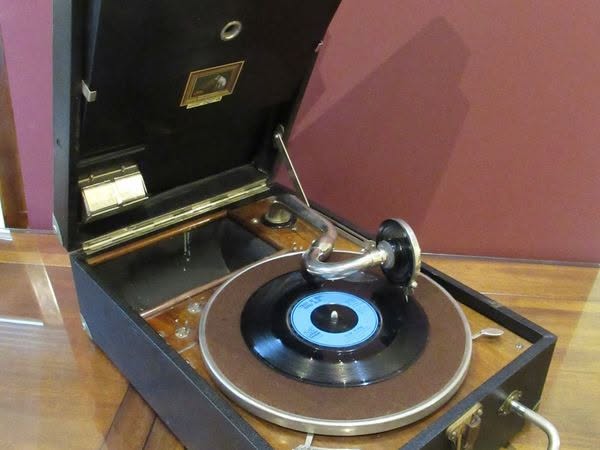
I often think about that. How on earth did Granny, living in a small, thatched cottage with so few possessions, come to own a gramophone? It seemed like a wildly glamorous object for such a place, like finding a grand piano in a cattle shed. In case anyone is imagining something more advanced, this was a wind-up model. You had to give it several determined turns just to get through one record, and even then, it sounded as though it might not make it to the end.
She had only one record.
Just one.
A 78rpm copy of Ebb Tide.
Now, I am sure Ebb Tide has its admirers, and I do not want to upset any devoted followers of melancholy orchestral music, but to my young ears it was one of the dreariest pieces of music ever created by man. It had all the cheerfulness of a wet Monday. Even as a child, I remember thinking that if this was what grown-ups called entertainment, they needed to get out more.
Still, the gramophone itself fascinated me. The winding handle, the heavy record, the needle dropping onto the disc, the scratchy sound before the music began. It seemed magical. There was something wonderful about a machine that didn’t need plugging in and yet could still fill a room with music, however gloomy that music happened to be.
My next brush with records came in my teens, by which time the world had moved on and so had the music. The Beatles were everywhere, and new releases came out on a Saturday. There was genuine excitement in going into town and queueing up for a new 45rpm single. That was modern life. That was the future.
By then, the gramophone had become a record player, and things were much more sophisticated. You placed the record on the turntable, chose the correct speed and away you went. There were three to choose from: 45rpm for singles, 33rpm for LPs, and 78rpm for anyone still hanging on to the old world. Which, I now realise, meant Granny was never as far behind the times as we thought.
Then I started work and, because I was still living at home and had more money than sense, I spent what must have been about two months’ wages on a Bang & Olufsen system.
Not a record player. A system.
By then, the proper term was “hi-fi”, which made it sound less like something you listened to music on and more like a piece of serious engineering that should be spoken about in hushed tones. Owning hi-fi, unfortunately, did strange things to a person. It made you unbearable. Instead of buying albums like Sgt. Pepper’s Lonely Hearts Club Band and enjoying myself like a normal young man, I started buying records designed to show off the sound quality. Train noises. Bagpipe music. Strange demonstration records full of things moving from one speaker to the other. “Listen to that,” I’d say to people, as if I had personally invented stereo sound. “You can actually hear the train coming in from the left.”
Nobody, I now realise, was as impressed as I thought they were.
Then along came the cassette tape, which I regarded at the time as a bit of a backward step. Records had dignity. They had proper covers. They felt like something. Cassettes looked like small plastic sandwiches. But progress waits for no man, and if you wanted to keep up, you bought a cassette player and pretended this was all perfectly reasonable.
Eventually, the cassette was swept aside by the CD, and off we all went again, dutifully buying another machine because the world had decided music now belonged on shiny little discs. So, I bought CDs as well, and for a while, we were told this was it. The final form. Perfect sound forever.
That turned out to be nonsense too.
The loft still contains a fair quantity of CDs, and I imagine most charity shops in Ireland are still trying to shift the rest. Then came digital music, and suddenly music was no longer a thing you bought and owned at all. It became something you paid for every month, like bins or broadband. Entire record collections were reduced to invisible files and monthly direct debits.
I managed to keep up, more or less. I adapted. I streamed. I moved with the times.
And then, on a visit to my son, I discovered that he had bought a 78rpm gramophone player.
A 78rpm gramophone player!
So, after all these years of moving from gramophone to record player to hi-fi to cassette to CD to digital streaming, the young people have apparently decided that the future lies in going right back to the start. The only difference is that now it is called vintage and costs a fortune.
I found this deeply funny.
All that progress, all those format changes, all those arguments about sound quality, all those machines bought in the sincere belief that this one would surely last, and here we are, back at a wind-up style record player like Granny had in Donegal.
The circle of life, only noisier.
He doesn’t have a copy of Ebb Tide, though.
And maybe that is for the best. Some things deserve a revival. Others had their chance the first time around.